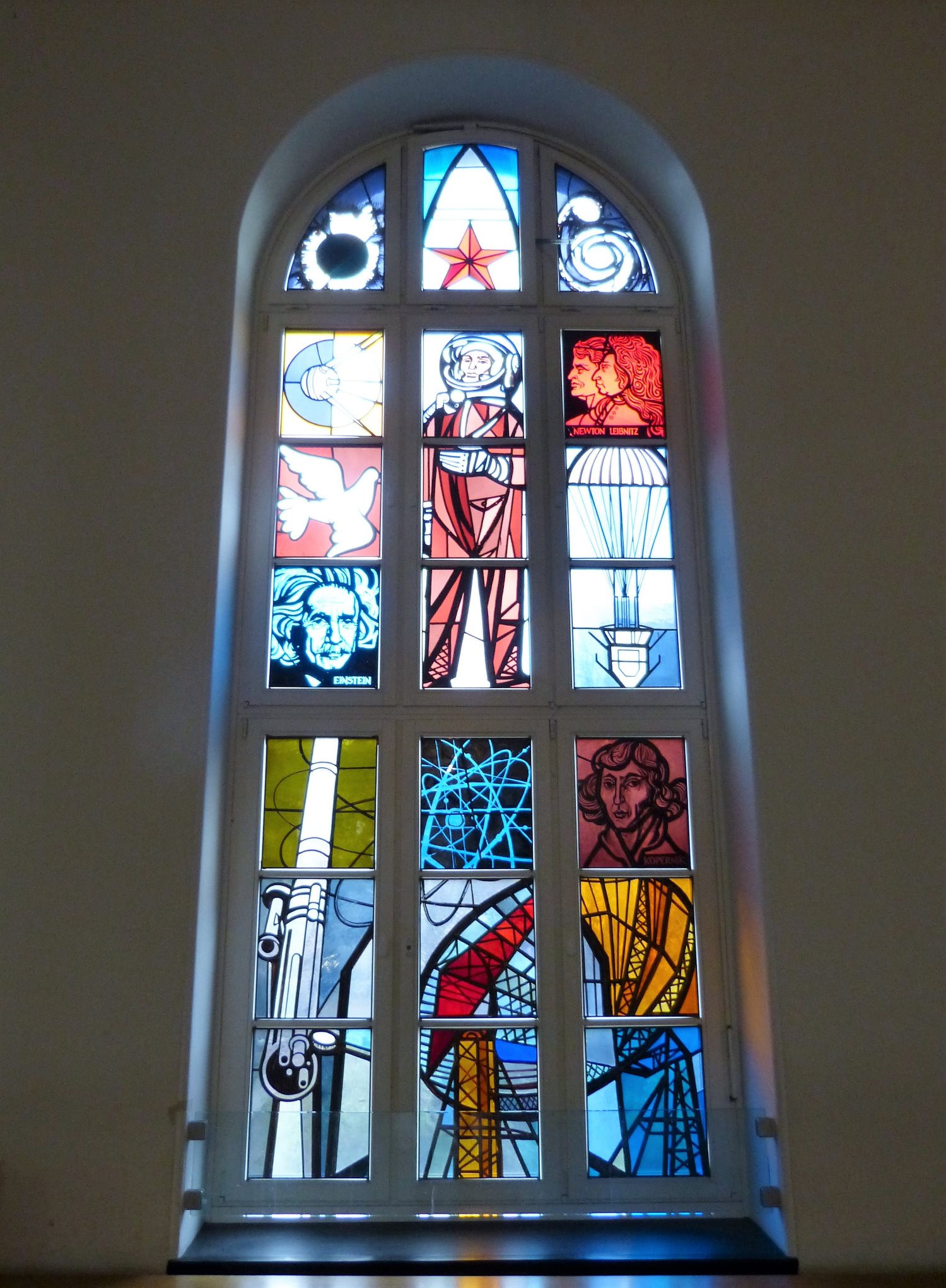
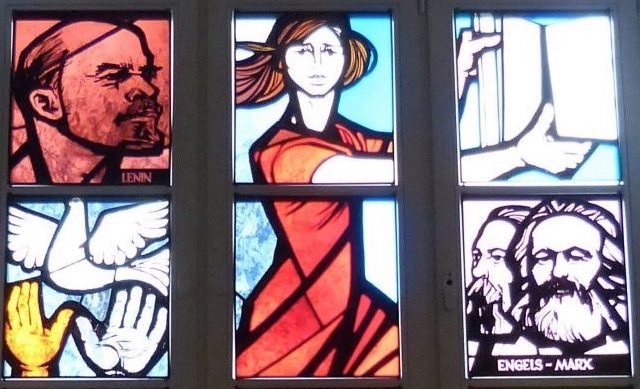
The right-hand window is particularly relevant to the present day. Here, a man in a space suit is the central figure, surrounded by a rocket hanging from a parachute, portraits of Leibniz, Newton and Einstein, and the dove of peace. In the case of Einstein, the reference is not only significant in terms of scientific history; the physicist and Nobel Prize winner also gave lectures in the main lecture hall of Berlin’s university. The red Soviet star next to the depiction of a black hole and a galaxy refer to the conquest of space, which Yuri Gagarin achieved in 1961 with his space flight. The theme of space conquest is symbolically linked to the importance of physics, scientific research and technical prowess in the lower fields of the image with a refractor, a parabolic antenna and the portrait of Nicolaus Copernicus.
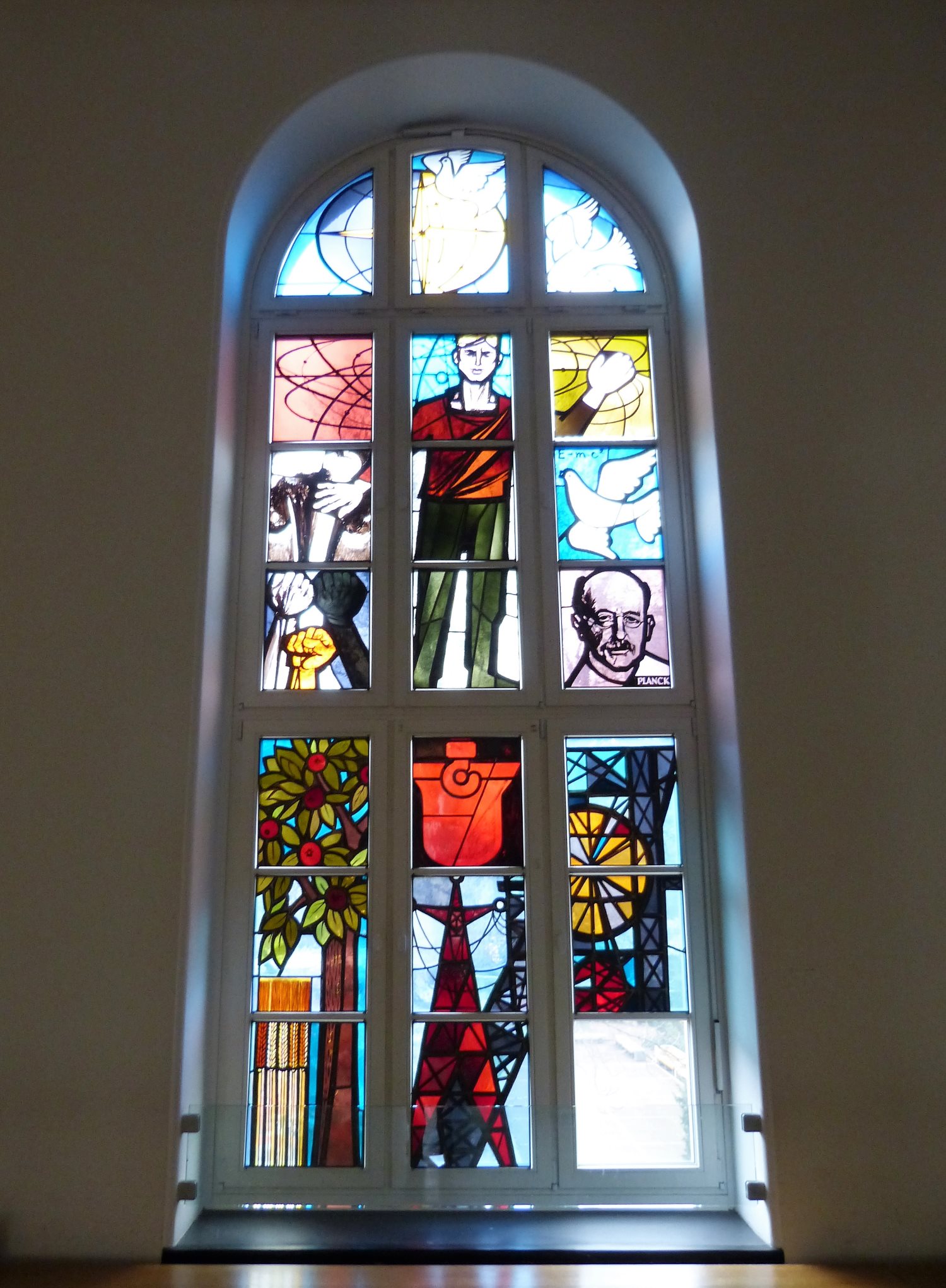
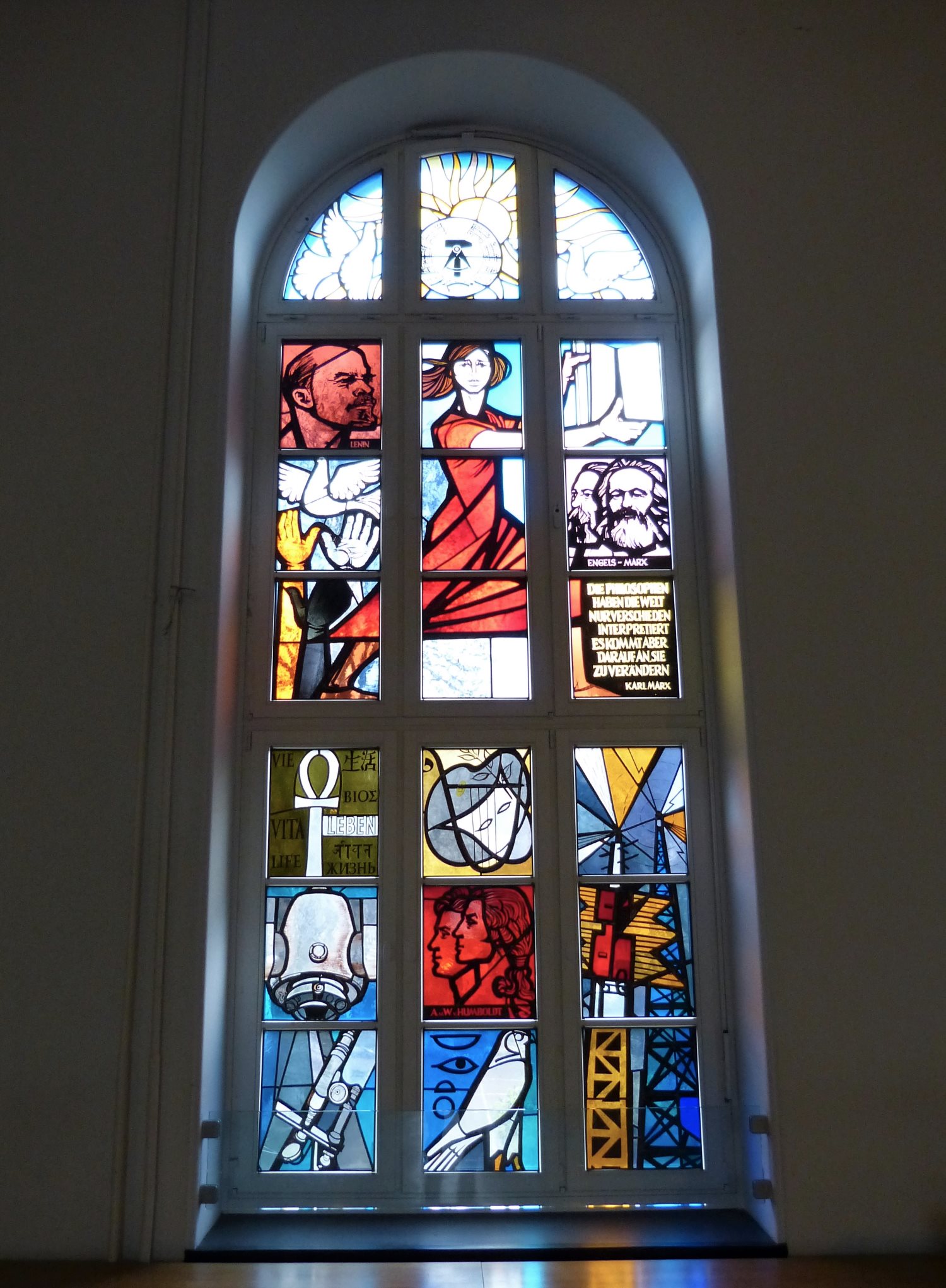
The mastery of nature and technology for the sake of peace is depicted in the stained glass windows as the task of the university in a socialist state in a sequence of individual motifs. Sometimes concrete, sometimes more metaphorical, many of the selected image elements were familiar set pieces from everyday media. Walter Ulbricht regarded innovative technology and science as a prerequisite for ‘the growth of productive forces and economic strength’ (“das Wachstum der Produktivkräfte und die ökonomische Stärke”) so that the ‘successful mastery of the scientific and technological revolution’ („erfolgreiche Meisterung der wissenschaftlich-technischen Revolution“) could be achieved as ‘a major task in the class struggle’ (“eine Hauptaufgabe im Klassenkampf”, Walter Ulbricht: Grundlegende Aufgaben im Jahr 1970. Referat auf der 12. Tagung des ZK der SED 12./13.12.1969). The so-called complex image, the dissolution of a narrative form into coherent individual motifs, artistically creates a world view in which science, technology, nature and society are closely linked and dominated by humans.
The stained glass windows also showcase modern technology, departing from the Christian stained glass tradition of church windows: small plexiglass panes are hung in front of the window bars, and the typical lead strips are only partially real, with some of them merely simulated by black lines. No sacred space is ennobled; rather, modern science and the human spirit of discovery that dominates the world are celebrated. The stained glass windows were created by Katharina Perschel, and the Mahlsdorf glass art workshop still exists today.
Walter Womacka was commissioned not only because of his expertise in architecture-related art, but also because of his socialist convictions, which he demonstrated in other large-scale projects. Not far from the Humboldt-Universität, he designed the stained glass window wall in the former seat of the State Council (the first new government building in East Berlin, now the European School of Management and Technology) in 1964. The main staircase is adorned with the ‘History of the German Labour Movement from 1918 to the Establishment of the First German Workers’ and Peasants’ State’ (Socialism Triumphs) (“Geschichte der deutschen Arbeiterbewegung von 1918 bis zur Errichtung des ersten Deutschen Arbeiter- und Bauernstaates“ (Der Sozialismus siegt)). The elaborate glass bonding technique used for this was developed by the PGH Kunsthandwerk und Glasgestaltung (Artisans’ Cooperative for Arts and Crafts and Glass Design) in Magdeburg – the artisanal and artistic technique thus underlines the importance of technical progress using one’s own skills.
The stained glass windows bear witness to a very special moment in art history, politics and social history, in which Humboldt-Universität also played a part.
Author: Christina Kuhli
Photos: Iris Grötschel, https://www.math.berlin/orte/fenster-hub.html [last access: 09.02.2026]