Category Archives: Object of the Month

Object of the month: Historical drawing of a new horse stable building

Object of the Month 03/2023 

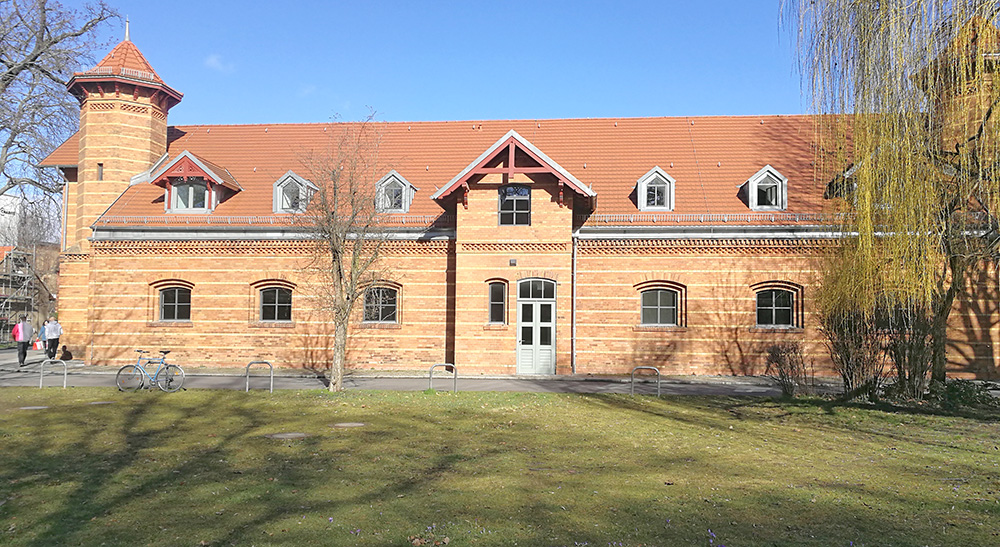
House 9 on the North Campus once served as the equine clinic of the former Prussian Royal Veterinary School, which was one of the leading training and research centres for veterinary medicine in the young German Empire. The northern part of the building was built in 1836 by Ludwig Ferdinand Hesse, the southern part in 1874 by Julius Emmerich as an extension. A drawing from the plan archive of the Technical Department provides information on the construction of the extension.
HU, Campus North, House 9
Campus North, House 9, Photo: Kerstin Hinrichs, 14 March 2023
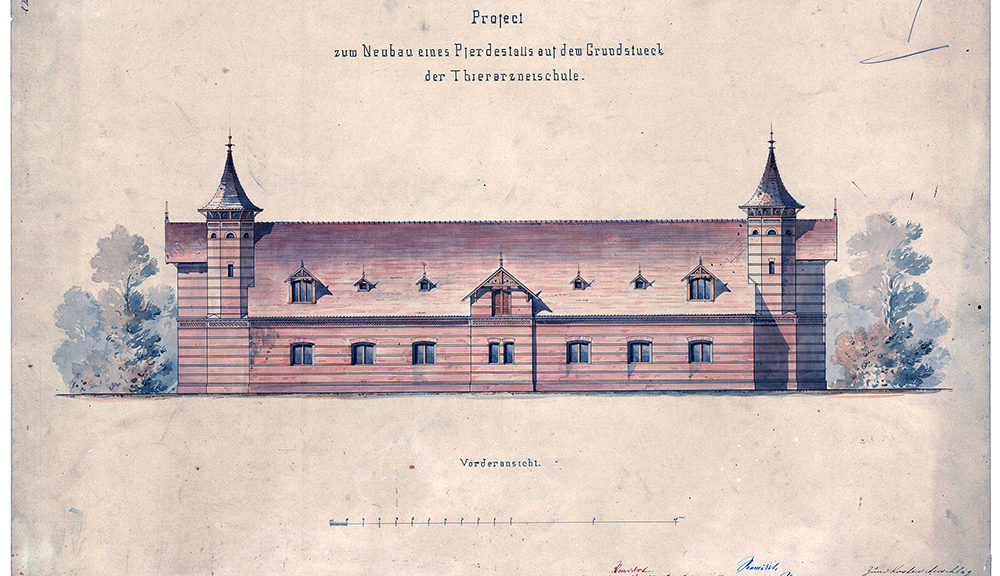
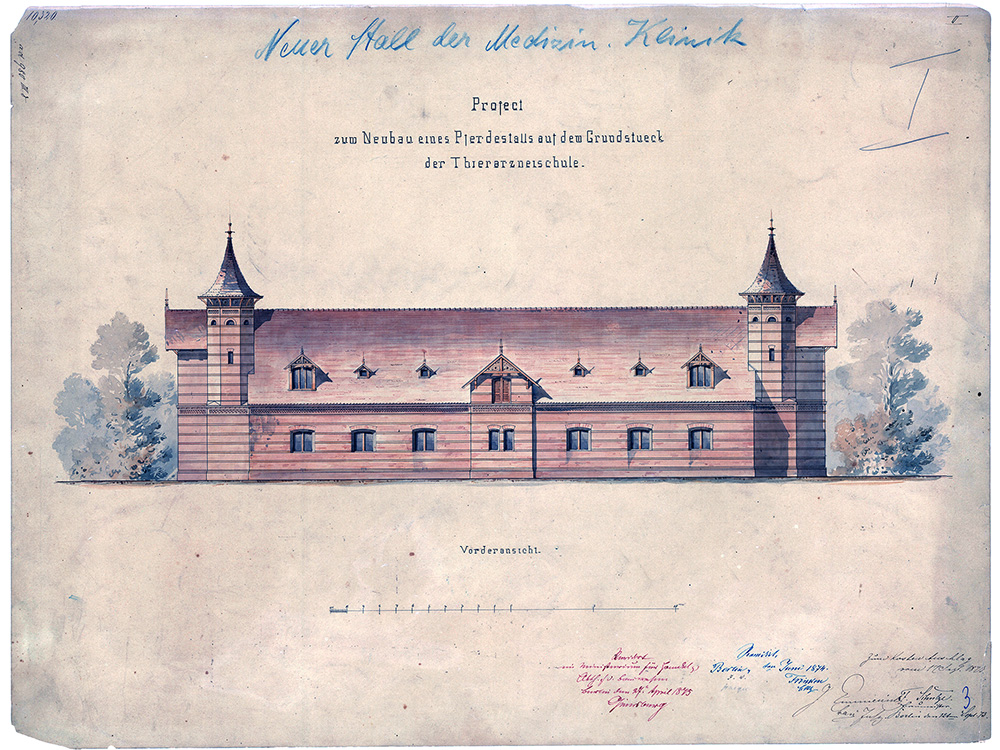
The drawing by the architect Julius Emmerich shows the front of an elongated single-storey stable building with a high roof, framed by stair towers and transoms on a scale of 1:100. The centre is emphasised by a risalit with a wood-decorated roof gable, and three window axes each on the left and right. On the ground floor, double-wing windows form a line with the skylights and thus vertically divide the cube. In the gable of the risalite, at the level of the attic, a double-leaf slatted door through which straw and hay could be stored in the attic. The towers served as access to the work and living rooms of the animal keepers in the transverse bays. The shape of the roof, the profiled beam heads and brackets, the accentuation of the cornices by moulded stones as well as the alternating coloured brick bands are depicted in great detail in the drawing. Emmerich’s design borrows from Schinkel’s designs for Prussian country house buildings. Trees and bushes frame the planned building and refer to the park character of the site.
project new horse stable
"Project for the construction of a new horse stable on the site of the Thierarzneischule", 59.8 cm x 45.4 cm, drawing, ink, wash on cardboard

The plan served as an appendix to the cost estimate for the building of 17 August 1873 and was submitted by Emmerich and countersigned by master builder F. Schulze on 12 September of the same year.
At that time, Emmerich was in the Prussian civil service and was in charge of the planning. On the basis of the other autographs, the remarks on the plan and the accompanying signatures, it is possible to trace the usual approval procedure for new buildings that was customary for the city of Berlin in the young Empire. Government building officer Ludwig Giersberg, an employee of the Ministry of Construction, Military, Trade and Finance, Department of Construction, confirmed the accuracy of the plan document. From 1866 onwards, Giersberg was entrusted in the Ministry with the preparation of expert opinions and the examination of building projects of outstanding importance in public construction. His signature under the plan, dated 27 April 1875, confirmed the planning for the new stables for the veterinary school. The text “Neuer Stall der Medizin. Klinik” using a blue pen probably goes back to the planning for necessary new buildings for the veterinary school at the beginning of 1908. At that time, 10,000 horses per year were already being treated in the existing buildings.

After the equine clinic was completed in 1839, the building was used as an animal stable and warehouse until the veterinarians moved to Dahlem in 1991. In 2014, extensive renovation and conversion work took place. Today, there are laboratory and seminar rooms on the ground floor and offices of the Institute of Biology on the upper floor.

Author: Kerstin Hinrichs, Technical Department

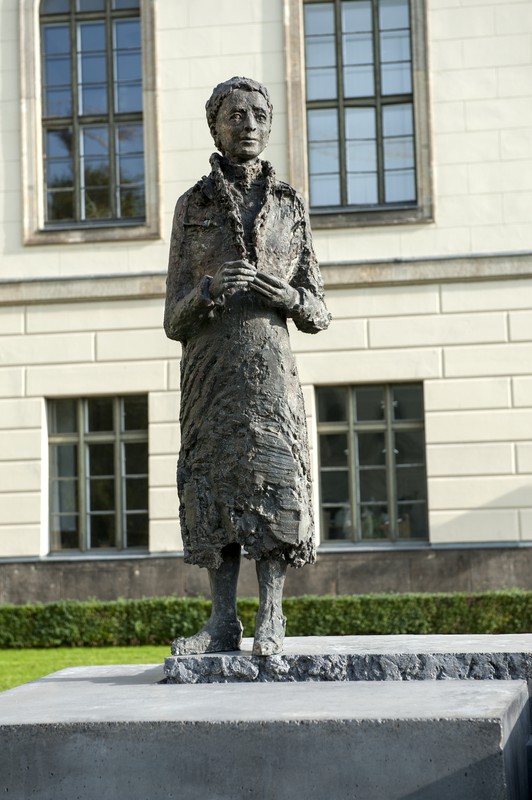
Object of the Month: Lise Meitner Monument by Anna Franziska Schwarzbach

Object of the Month 01/2023

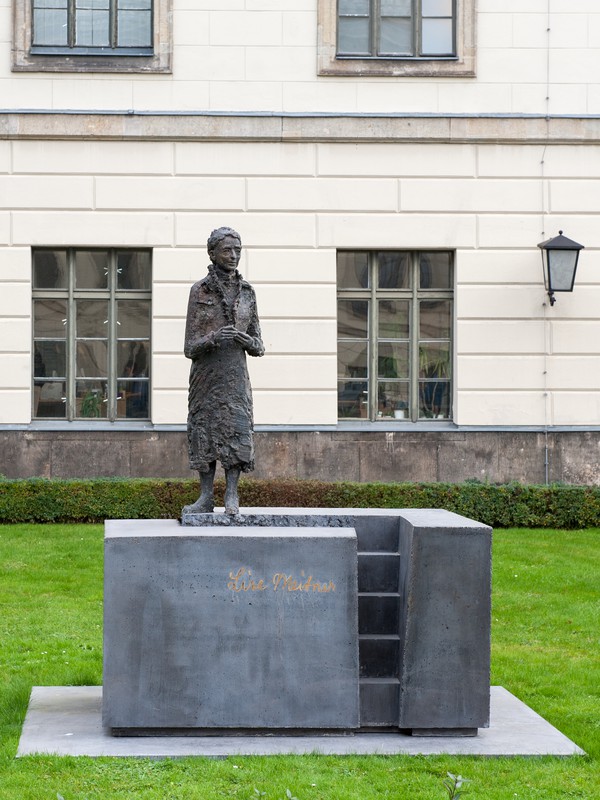
Lise Meitner Monument

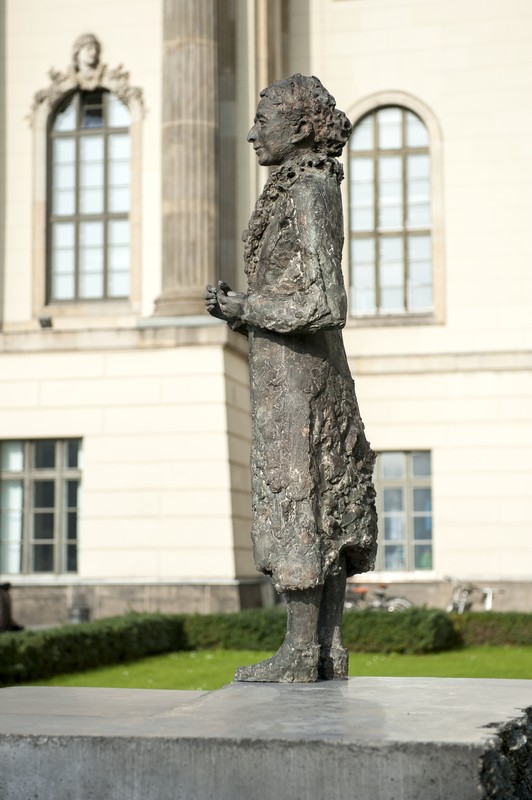
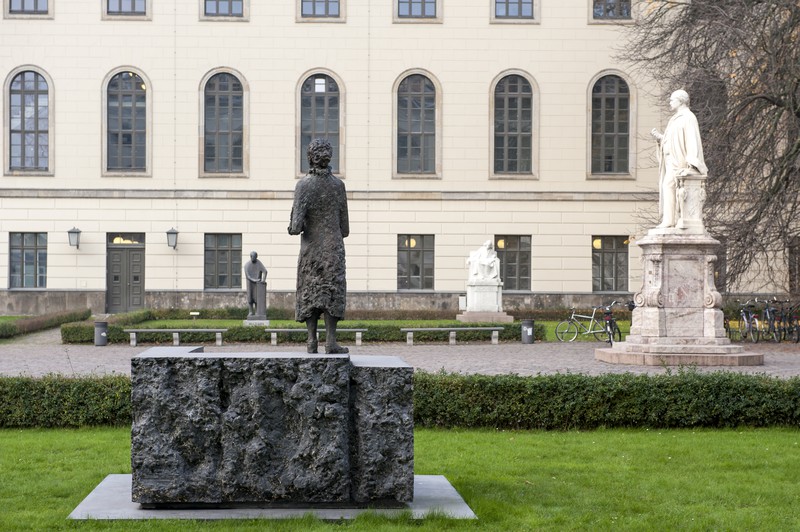
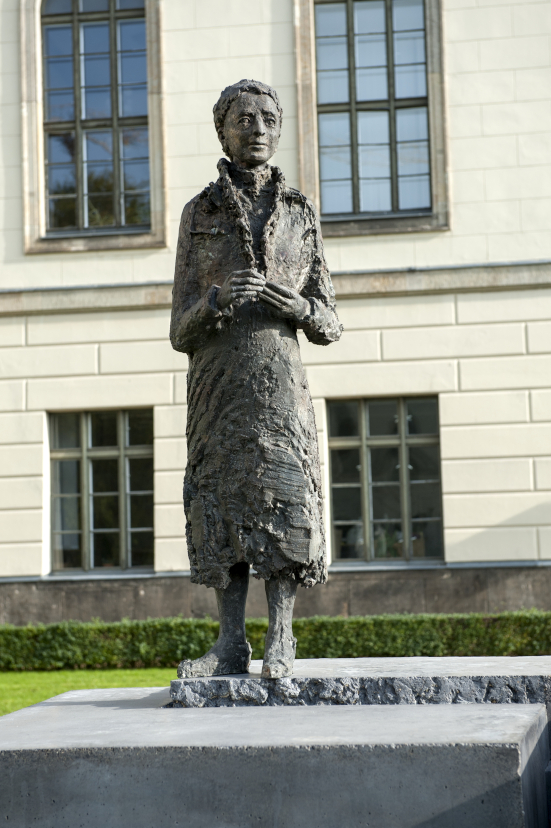
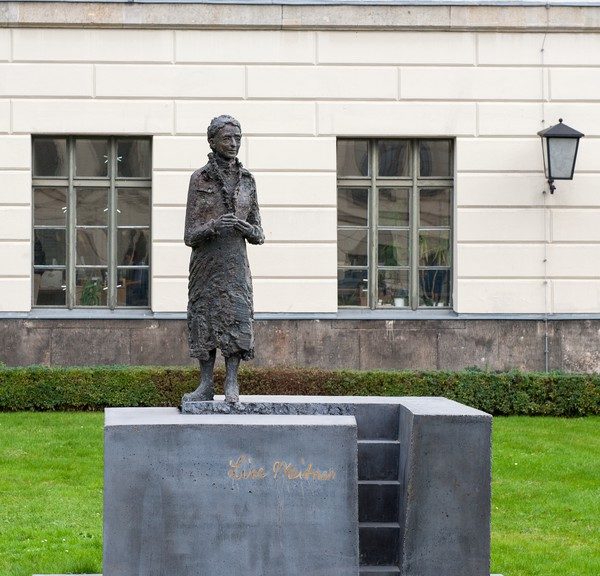
Since 2014, Lise Meitner faces Unter den Linden; on the other side of the cour d'honneur of the main building, Theodor Mommsen and Max Planck face her. The monument to Hermann von Helmholtz completes the historical series, which is broken up and continued both in terms of contemporary history and aesthetics by Lise Meitner's representation - no longer larger than life and in a space-consuming pose, but set back and asymmetrically on the plinth. The bronze monument to Lise Meitner (1878-1968) is the youngest in the university's cour d'honneur and the only one to date to honour a female scientist. Lise Meitner (1878-1968) combines many special features in her scientific biography: she was the second woman to receive a doctorate in physics from the University of Vienna in 1906; in 1913 she was the first woman to become a scientific member of the Kaiser Wilhelm Society; she was the first woman to work as an assistant to Max Planck; in 1922 she became the first female physicist in Prussia to habilitate at the University of Berlin; and finally, in 1926, she was appointed as the first associate professor for experimental nuclear physics. In retrospect, she herself describes the fact that she took her work with the students very seriously as "a great human responsibility for our young colleagues, with whom we are together all day and for whose overall human development everything we do and say can have an influence".
Lise Meitner Monument

Nuclear power for peaceful use

Even before her theoretical interpretation of nuclear fission in 1939, she received the first of a total of four nominations for the Nobel Prize in 1919 – but she did not receive the Nobel Prize itself. This honour was bestowed on Otto Hahn in 1945, with whom Lise Meitner worked and researched together for decades – and whom she sometimes referred to, self-confidently teasingly, as “chicken”. She became known to the scientific community early on and met Marie Curie and Albert Einstein personally. As a Jew, she was forced to give up her scientific work by the Nazi Law for the Restoration of the Professional Civil Service, which was passed in 1933. In 1938, she was able to emigrate to Sweden. There, from 1947 to 1960, she held a research professorship and was head of the nuclear physics department at the Stockholm Institute of Technology. From then on, she devoted herself not to the construction of the atomic bomb, but to the peaceful use of nuclear energy. After her retirement in 1960, she moved to Cambridge, where she died eight years later, having received many international honours and awards.

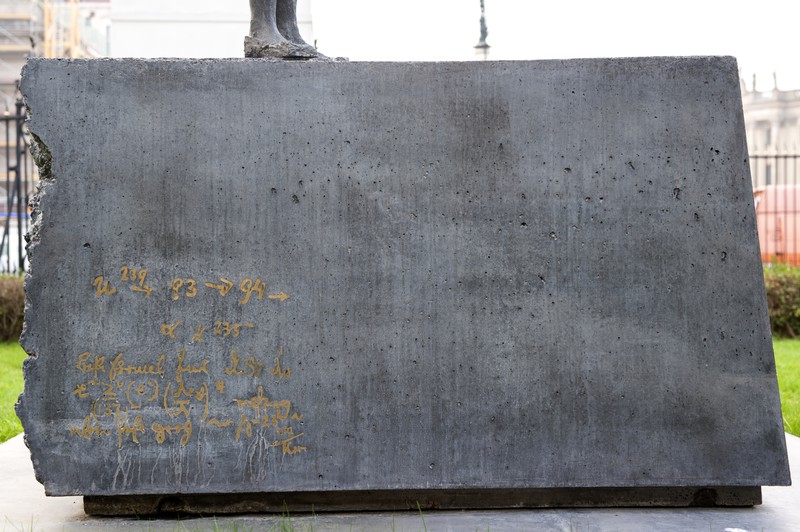
Monument with signature, nuclear reaction and calculation

The Berlin sculptor Anna Franziska Schwarzbach won the European art competition with her design for the Lise Meitner Monument. The site also almost occupies the place where the monument to Heinrich von Treitschke once stood – the historian who triggered the Berlin anti-Semitism controversy with his sentence “The Jews are our misfortune” and whose monument was finally removed after being moved by the National Socialists in 1951.
Lise_Meitner
Anna Franziska Schwarzbach
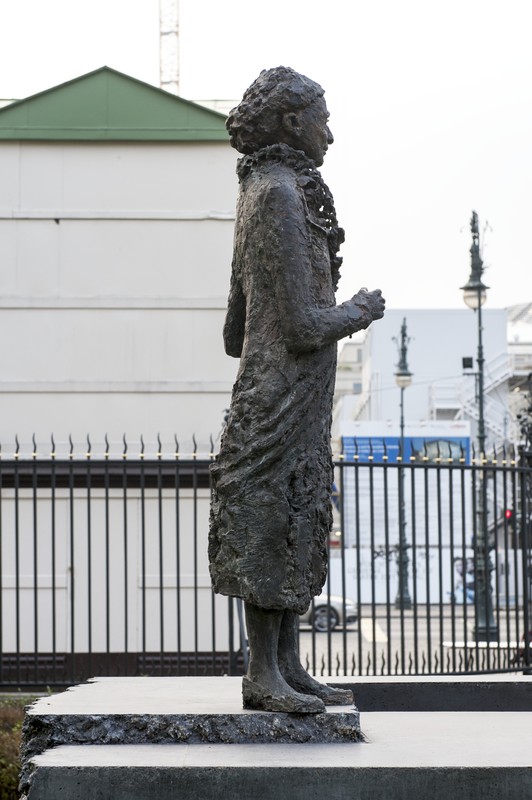
Schwarzbach contrasts the relationship between the figure and the plinth: on the base plate lies a plinth with various cuts and cracks that are associatively linked to the fractures in Meitner’s biography. The portrait-like figure itself stands somewhat apart, at once delicate and small and prominent, representing marginalisation as much as merit. On the front of the plinth is Lise Meitner’s signature, on the smooth left side surface a drawing of the nuclear reaction and fragments of a calculation. Thus the attributes have also migrated to the plinth and are not attached to the figure. Criticised as decorative, following female stereotypes and lacking the potential for irritation as an impulse to reflection, the monument is subordinate to the coherent appearance of the Court of Honour. On the everyday walk into the main building of the university, the Lise Meitner Monument nevertheless evokes German history, university and scientific history as well as questions of equal rights – whether it is an anachronism should be decided by each:r.

Author: Christina Kuhli, Custodian of the HU
Art Collection / Custody of the Humboldt University

Photos: Matthias Heyde