Category Archives: Third Mission

Workshop-Conference: Learning, Teaching, and Researching with Society

Engagement with societal stakeholders is one of the four key pillars of the UNESCO Recommendation on Open Science: individuals and institutions from society should be actively involved in the creation of knowledge and scientific processes should be made more transparent, inclusive and accessible to a broader public through participatory collaboration.

The HU Office for Public Engagement and Knowledge Exchange with Society at the Zentrum für Kulturtechnik and the BUA Open Science Ambassadors program invite all interested to discuss such innovative collaboration and formats of knowledge exchange between academic, artistic and civil society perspectives at the workshop conference. (Please register here for all or for selected events of the day, please note that some events will take place in German.)

The event highlights collaborations from participatory research and teaching, curatorial practice, as well as artistic-scientific collaboration at Humboldt-Universität. A particular emphasis is placed on the practice of translation between various stakeholders from academia and society in order to shape knowledge production as a shared, dialogical process. The event reflects on translation practices between research and application, between teaching and non-university spaces, and between scientific, artistic, and lived forms of knowledge.

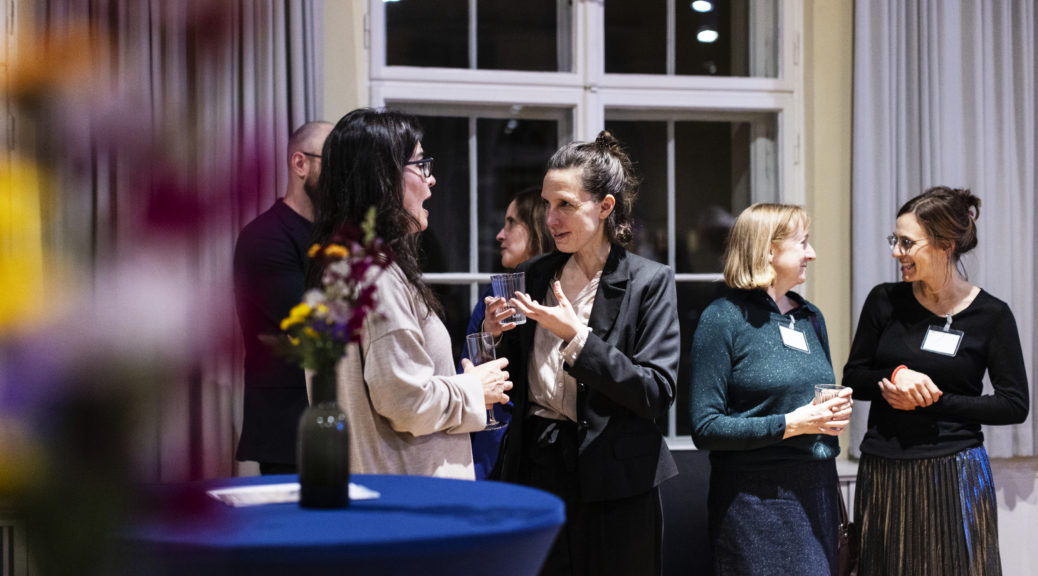
The event provides a space for networking, informal exchange and sharing of hands-on experiences on implementing innovative formats and collaborations in research and teaching in order to contribute to the goals of Open Science: sustainable transparency and inclusivity of science, equitable collaboration and societal participation, and the de-hierarchization of knowledge production.

Time: Friday, June 12, 2026

Place: Zentrum für Kulturtechnik, HU Campus Nord, House 3, Philippstr. 13, 10155 Berlin

Registration: Workshop Conference

Conference Program
Pre-Conference (upon invitation, in German)
09:30-11:30 Pre-Conference: Strategy Workshop for Participatory Research and Teaching at HU Berlin: The exchange between academia and society has always been central to the identity of Humboldt-Universität zu Berlin. Building on this commitment, the university wants to continuously develop its structures and collaborative partnerships to strengthen open science and promote learning, teaching, and research through participatory and transdisciplinary approaches. The workshop focuses on future strategic objectives of public engagement and knowledge exchange with society initiatives at HU. It discusses necessary institutional changes, support structures for engaged university members and next steps. In a World-Café format, participants are invited to exchange perspectives and participate in developing a future strategy.   
 
Moderation:
Antje Nestler, Co-Creating Futures; Dr. Kristin Werner, Käte Hamburger Kolleg inherit. heritage in transformation, Humboldt-Universität zu Berlin / Co-Creating Futures
11:30 Welcome and Coffee
Panel-Discussion „Between University and Society“ (in German)
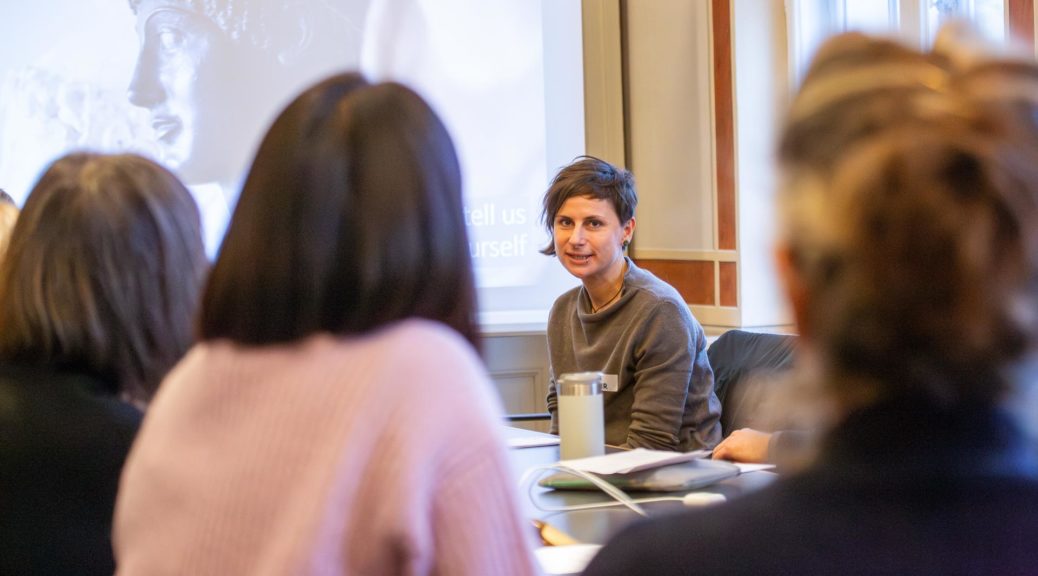
12:00-13:30 Panel-Discussion „Between University and Society: Translate, Mediate, Unlearn. Reflexive Practices of Knowledge Production”: The intended panel discussion views knowledge exchange as a form of reflexive translation practice between the university and society and will focus on experiences from transdisciplinary teaching, participatory research and arts-science collaboration. The discussion will explore how knowledge production can be shaped without reproducing existing hierarchies and exclusions and what role reflection, unlearning, and situated practice play in this process. At the same time, the panel does not merely discuss translation, mediation, and unlearning, but addresses these questions by reflecting on project experiences using the DCRP approach (Decolonial Critical Reflective Practice). The discussion will particularly examine the disparity between initial expectations and the experiences gained during implementation, and create a space to reflect on tensions and misunderstandings in the research process as well as the associated learning processes.   
 
Moderation:
Dr. Alia Rayyan, Researcher  “Theory and Practice of Curating,” Humboldt-Universität zu Berlin
 
Guests:
– Dr. Nadja-Christina Schneider, Department of Asian and African Studies, South Asian Studies, Humboldt-Universität zu Berlin
– Adela Taleb, Department of European Ethnology, Humboldt-Universität zu Berlin
– Dr. Pegah Byroun-Wand, Institut of Art Studies and Historical Urban Studies, Technische Universität Berlin
13:30-14:20 Lunch Break
In-Practice Discussion „Teaching and Learning with Society und Lehren“ (in German)
14:20-15:20 In-Practice Discussion I: Situated Practice & Place-Based Learning: The discussion focuses on concepts, methods, and practical experiences with approaches to learning in collaboration with society, specifically related to situated practice and community-based learning. Learning is understood as a process embedded in social, spatial and societal contexts, in which students and projects collaborate with non-university partners and local communities, linking academic questions to real-world societal challenges. The session will discuss opportunities, challenges and conditions surrounding participatory and place-based projects that design academic work as a shared, reciprocal space of knowledge and include societal perspectives.     
 
Moderation:
Dr. Jana Wendler, Berlin School of Public Engagement and Open Science
 
Guests:
– Prof. Dr. Elisabeth Verhoeven, Department of German Language and Linguistics, Humboldt-Universität zu Berlin
– Juana Awad, Researcher, Curator, inherit Fellow 2024/25
– Dr. Léa Perraudin, Department of Cultural and Media Theory, Matters of Activity, Humboldt-Universität zu Berlin
– Paz Ponce, Curator for Outreach,  Tieranatomisches Theater, Humboldt-Universität zu Berlin
15:30-16:30 In-Practice Discussion II: Practicioners in Teaching and Teacher Training: This discussion explores how to successfully involve external partnerships and society participants in teacher education. Collaborations with schools, civil society initiatives, cultural institutions and local organizations enable prospective teachers to integrate pedagogical practice with social perspectives, to understand schools as part of a social and democratic environment, and to experiment with creative methods in learning and teaching. The panel facilitates a discussion on potential opportunities, creative collaborations and experiences in working with societal partners in teacher education.      
  
Moderation:
Prof. Dr. Niels Pinkwart, Vice President for Academic Affairs, Humboldt-Universität zu Berlin
  
Guests:  
– Prof. Dr. Petra Anders, Department of Education, Humboldt-Universität zu Berlin
– Dr. Julia Frohn, Central Institute Professional School of Education, Research and Transfer, Humboldt-Universität zu Berlin
– Maike Löhden, Department of Education, Humboldt-Universität zu Berlin
– Irina Demina, Choreographer, artistic researcher, teacher
16:30-17:00 Coffee Break
Performative Encounters „Embodied Futures: Knowledge and Movement“ (in Englisch)
Embodied Futures: Knowledge and Movement: What role does the body play as a source of insight in a post-digital knowledge culture? What epistemic perspectives do body-based approaches open up for learning and research processes that are traditionally strongly cognition-centered? Two interactive presentations and a panel discussion will demonstrate how creative collaborations between science, art, and society address these questions. The event provides insight into projects of the new Public Engagement Hub “Embodied Futures: Knowledge and Movement” at ZfK. The Hub views knowledge production as a collaborative process and supports projects and teaching formats that explore creative embodied approaches as research method, teaching medium and outreach format, and develop scientific-artistic-practical work as participatory practice.
17:00-17:50 Performative Encounter I: Prof. Dr. Shintaro Miyazaki & Irina Demina
18:00-18:50 Performative Encounter II: Anna Schäffner & Michaela Filzi
19:00-20:00 Panel-Discussion on Public Engagement Hub “Embodied Futures: Knowledge and Movement”.   
  
Moderation:
Leonie Kubigsteltig, Office for Public Engagement and Knowledge Exchange, Zentrum für Kulturtechnik

Guests:

– Irina Demina, Choreographer, artistic researcher, teacher
– Anna Schäffner, Matters of Activity, Humboldt-Universität zu Berlin
– Michaela Filzi, Multidisciplinary artist, dancer, eco-somatic researcher 
– Dr. Jeanette Ehrmann, Department of Social Sciences, Political Theory, Humboldt-Universität zu Berlin
Following Drinks and Networking

Organized by

  • HU Office for Public Engagement and Knowledge Exchange with Society at the Zentrum für Kulturtechnik, HU Berlin’s central office for participatory research, teaching, and practice
  • ZfK department “Theory and Practice of Interdisciplinary Curating,” Chair for inter- and transdisciplinary engagement with curatorial practices (supported by Bundesbeauftragten für Kultur und Medien)
  • BUA Ambassadors for Open Science program with Xenia Muth and Dr. Alia Rayyan (Zentrum für Kulturtechnik) as Open Science Ambassadors 2025–26

   

Photo: Stefan Klenke
Learning and Teaching with Society in Summer Term 2026

As part of the “Teaching and Learning with Society: Transdisciplinary Course Program,” faculty and students explore how learning can be shaped within and in collaboration with society.

In collaboration with artists, cultural institutions, and civil society initiatives, the selected courses in the summer term 2026 incorporate societal experiences and community knowledge, including artistic archival and collection work, site-specific knowledge and anti-discrimination discourses. They explore artistic approaches to topics such as culture, health and pollution in Berlin, and utilize movement-based methods of knowledge processing in political theory and social movements.


1. “The Fifth Wall – Navina Sundaram. Working with a digital and physical archive”

Prof. Dr. Nadja-Christina Schneider (Institute for Asian and African Studies)

The seminar combines work with the online archive “Die Fünfte Wand – Navina Sundaram” (The Fifth Wall – Navina Sundaram), that compiles journalistic, cinematic and personal materials on migration, feminism, decolonization and media criticism and practical engagement with original materials in the object lab at ZfK. The students will reflect archives as places of societal knowledge production.  Cooperating with experts from the fields of education, artistic film and archival practices, the course incorporates non-academic perspectives and offers six public events.


2. Theater in Practice: Living Archives

Dr. Constanze Baum (Institute fpr German Literature)

As “Living Archives,” objects, texts and their histories from HU archives and literature-related collections will be brought to life in this course at the Theaterhaus Mitte and in the Object Lab at the ZfK. Using exercises and methods from performing arts and impro theater, students will explore ways to express themselves through voice, body, gestures, and facial expressions, and develop short individual and group scenes. Research, development and documentation of such “object staging,” as well as a pop-up performance of selected scenes during the Long Night of Science are part of the course.


3. Taking a stand as a teacher? Dealing with anti-democratic tendencies and extremism in schools and classrooms

Dr. Julia Frohn (Professional School of Education, PSE)

In collaboration with the association “Aufstehen gegen Rassismus” (Stand Up Against Racism), the seminar addresses the role of teachers in dealing with anti-democratic tendencies and extremism. It reflects on what it means for teachers to “take a stand” and what scope for action teachers have in schools and classrooms. The accompanying exercise examines political mobilisation on TikTok with a focus on memes as carriers of extremist content. Students analyse their potential impact and develop own democracy-promoting memes for democracy and media education.


4. Critical Film Education – between School, Cinema, and Society

Charlotte Wiesner (Institute for Education Sciences)

In this film education seminar for prospective elementary school teachers, students engage in an open exchange with practitioners from society to consider how film education that is critical of discrimination can be designed for the classroom. The seminar takes a research-based and participatory approach and involves practitioners from the BIPOC community and from the film and cinema landscape (e.g., film libraries, Vision Kino – Network for Film and Media Competence, cinemas, filmmakers).


5. Berlin.Culture.City.

Prof. Dr. Friederike Landau-Donnelly ( Geography Department, Cultural and Social Geography)

The aim of the seminar “Berlin.Kultur.Stadt.” is to convey interdisciplinary perspectives on the ‘creative’ city of Berlin. Via student-generated mappings of various cultural spaces, districts, and infrastructures in Berlin and in cooperation with civil society partner Kulturraum gGmbH, that launched the “Kulturkataster” (cultural register), students explore Berlin’s cultural and urban development-related policies that shape it as city of culture. As part of a final exhibition and transdisciplinary knowledge transfer, students provide insights into the spatial geographic exploration of cultural sites.


6. Health and Art Narratives in Berlin. Institutions, collective practices and artistic approaches

Maria Morata (Berlin Perspectives)

How do contemporary artistic practices approach and challenge the binary of health and illness? Framed within Disability Studies and Crip Theory, the course explores artistic experiences of illness and vulnerability as platforms for social transformation and as emancipatory tools for navigating a normative and ableist world. Featuring Berlin-based artists and collectives, curators and scholars, the course also includes visits to the Berlin Museum of Medical History and the Tieranatomisches Theater at Humboldt-Universität.

„Embodied Futures. Knowledge and Movement“

As part of the new Public Engagement Hub at ZfK “Embodied Futures: Knowledge and Movement,” support is provided for courses that explore creative movement approaches as research method, teaching tool and format for outreach, and understand academic, artistic and practice-based research as a participatory form of knowledge production.

7. Hazardous Hope. Explorations through contaminated Berlin

Dr. Léa Perraudin (Department of Cultural and Media Studies,  Exzellenzcluster Matters of Activity)

“Hazardous hope” – as Ayushi Dhawan and Simone M. Müller (2024) term a practice that, amid permanently contaminated environments, experiments with new forms of cohabitation rather than hoping for purity or redemption. We undertake explorations through contaminated Berlin to engage its material politics via embodied and speculative methods, in dialogue with civil society actors, community initiatives, and artists.


8. Social Media and Social Movements

Prof. Dr. Shintaro Miyazaki (Department of Cultural and Media Studies)

Social media not only inform about global political and social developments but also significantly shape the everyday lives of many citizens and contribute to polarization. From a media studies perspective, the course examines how these dynamics emerge and what role social media might play in fostering sustainable social movements. Together with choreographer Irina Demina, an experimental approach will be explored that extends role-playing activities (Resnick & Wilensky) through choreographic and embodied methods in order to investigate social dynamics and processes of polarization through experience.


9. Body, Gender, Public Sphere: An Introduction to Iris Marion Young’s Feminist Political Theory

Dr. Jeanette Ehrmann (Department of Social Sciences)

In this seminar, we explore Iris Marion Young’s feminist political theory through her essays on female body experience. We examine how inequality and oppression shape embodied experience and connect these insights with intersectional perspectives on ableism, classism, and racism as well as on trans* and non-binary gender identities. The seminar is organized in collaboration with an artist within the hub “Embodied Futures: Knowledge and Movement” and integrates embodied knowledge, movement, and theoretical reflection.


Public Engagement Training for Researchers

The Humboldt Graduate School (HGS), in cooperation with the HU Office for Knowledge Exchange with Society and the Berlin School of Public Engagement and Open Science, is offering a Public Engagement workshop for early career researchers:

In this workshop, we will explore the basics of public engagement (PE) and its value for research and practice. Participants will be guided through a combination of theoretical inputs and practical exercises that will help them integrate PE into their work. The first part of the day will focus on the building blocks of PE and identifying the participants’ individual purpose for working with different target groups. In the afternoon, the workshop will delve deeper into the practical aspects of designing PE interactions, including planning and tracking their impact.

  • Time:  February
  • Place: Humboldt Graduate School, Luisenstraße 56, 10117 Berlin, Room 220
  • Format: In-person workshop in English
  • Target Group: Researchers in their final phase of the doctoral studies or postdoc phase

Registration: to participate please register until Feb. 11, 2026, at https://hu.opencampus.com/de/node/12744

Photo: Philipp Plum

Supporting Exchange Between Science and Society: Insights into a Public Engagement Internship

Interview with Jayun Choi, Brown University

Jayun Choi spent her fall semester 2025 at Humboldt-Universität completing an internship at the Office for Public Engagement and Knowledge Exchange with Society at the Center for Cultural Techniques. She supported university-wide programs for ​​public engagement and helped organize the Fluid Interdisciplinarities Festival. In the interview, she shares her impressions of supporting the exchange between science and society.


What is one insight that you got about the topic of Public Engagement at a university, about how an exchange between science and society may work? 

One key insight for me is that public engagement is not primarily about delivering science or translating academic knowledge to the public, but about creating spaces for mutual exchange where people can participate, question, and contribute. This became especially clear during Berlin Science Week, where Irina Demina, the choreographer-in-residence of the Centre for Cultural Techniques, opened her research on the intersection of folk dance and artificial intelligence. Rather than explaining her work in abstract terms, she invited the audience to experience her research through movement, encouraging people to ask questions and reflect on how embodied practice can function as a form of research. This experience highlighted for me how effective public engagement operates as a process of shared inquiry, where science and society meet through lived experience, curiosity, and exchange.

What was a project within your internship that you found most meaningful? Why?

One of the most meaningful projects during my internship was working on the public communication of research and artistic programs through social media and festival materials. In creating content for initiatives such as Berlin Science Week, Open Humboldt Freiräume funding program or the Dance Artist in Residence programme, I focused on making complex research and artistic practices available for wider audiences. This process sharpened my understanding of research and science communication as an act of framing where editorial choices shape how institutions represent knowledge in the public sphere. I also came to see how universities build trust, visibility, and engagement through the intentional communicative decisions that connect scholarship and the public.

Within the Fluid Interdisciplinarities Festival, what was the part of the event that best brought together research, art and society for you?

Within the Fluid Interdisciplinarities Festival, Party of the Panke stood out to me the most as the moment where research, art, and society most visibly converged. As an open event with multiple participatory stations, it offered different ways of engaging with rivers, including archival mapping, guided participatory walks or a movement-based workshop. Rather than presenting research as something to be observed or explained, each station invited participants to relate to the river directly through artistic and embodied methods. This made one’s participation feel like a form of knowledge-making rather than an audience reception. It showed me that research can enter public space by diversifying its modes of encounter, enabling science, art, and society to meet through shared experience rather than one-directional presentation.

During your internship, did you encounter a topic, an idea, a spark that will stay with you or that you will take away for your future research or work?

During my internship, learning about the various approached to research on Water by Berlin-based scientists became a lasting spark that reshaped how I understand environmental policy and governance. Engagement with the Fluid Interdisciplinarities Festival played an important role in shaping this perspective, leading me to explore related water-focused initiatives across Humboldt-Universität and the Berlin University Alliance. This insight was further reinforced through water-related research in the “On Water. WasserWissen in Berlin” exhibition at the Humboldt Labor. Encountering projects on urban rivers, water infrastructure or climate adaptation led me to pay closer attention to how water governance becomes visible to the public. As a student concentrating in International and Public Affairs and on East Asian Studies, this led me to develop a more focused comparative research interest in how urban water governance is framed and shared with the public through public-facing projects across different historical and institutional contexts. This interest emerged through my internship and is something I would like to pursue further in my future research.


The interview and internship supervision were led by Xenia Muth, Office for Public Engagement Knowledge Exchange with Society. For a current internship opportunity in Public Engagement and Knowledge Exchange with Society see the Humboldt Internship Program.

Teaching and Learning with Society: Call for Proposals Summer Term 2026

The call for applications for ‘Teaching and Learning with Society’ for the summer semester 2026 is now open. If you are interested, please apply by 18 January 2026!

The program “Teaching and Learning with Society: transdisciplinary course program” supports teachers across disciplines in shaping academic questions and seminar work in cooperation with society. The aim is to integrate experience and knowledge from society into teaching and university work with students, to learn from various actors in civil society, culture or politics and create an equal exchange.

The office for Knowledge Exchange with Society at the Center for Cultural Techniques supports seminars that work in a transdisciplinary or participatory way and include elements of exchange with society or public engagement. This may include:

  • Cooperation with appropriate societal actors / organizations
  • Cooperation in the organization or presentation of course content, in the form of co-teaching or using other methods that aim to incorporate expertise from outside academia
  • Course design with aspects of community-based research/learning
  • Cooperation with societal groups or organizations for the presentation/display of course results
  • Courses that combine material practices, object- or body-centered approaches in teaching with external collaborations

Support is provided through:

  • Funding of up to 1,000 euros per course for materials, guest lectures or workshops (expenses according to HU regulations); note that this is additional funding for existing or planned courses by HU-teachers, it does not finance an entire semester-long “Lehrauftrag”
  • Use of space at the Object Lab on Campus Nord, including flexible room equipment
  • Occasional event assistance by arrangement
  • Support/advice from HU team Knowledge Exchange with Society (approx. 2h per week)

Eligible for funding are:

  • Expenses for BA or MA seminars at HU Berlin in summer semester 2026 (funds remain with the Center for Cultural Techniques and are managed by the team)
  • Seminars that take place in the Object Lab on Campus Nord or are held elsewhere but connect in some way to the place or focus of the Centre for Cultural Techniques (ZfK).

To apply:

HU-Teachers and seminar instructors are welcome to contact wissensaustausch.zfk@hu-berlin.de and send the following information until January 18, 2026 to apply for the programme in summer semester 2026:

  1. Short course description
  2. Motivation and description of the transdisciplinary/participatory collaboration with external society actors/organizations
  3. Brief budget outline with expected or needed expenses
  4. Outline of the required course/event/object support

Contact:

Xenia Muth / Leonie Kubigsteltig
HU Office for Knowledge Exchange with Society
Email: wissensaustausch.zfk@hu-berlin.de
Phone: +49(0)30 2093-12892 | -12881

Training program for Researchers: Public Engagement and Knowledge Exchange with Society

The team of HU ‘Knowledge Exchange with Society‘ at Zentrum für Kulturtechnik (HZK) invites researchers to participate in a training program for Public Engagement, delivered by the Berlin School of Public Engagement and Open Science. The workshop series is an effective and flexible introduction to public engagement/ knowledge exchange between science and society. It offers the possibility to gain a certificate in the field of participation and engagement.

  • What: Training program (Ger/Eng) with 3 thematic modules and optional units: 1. Foundations – Engagement in Practice, 2. Evaluation Practice, 3. Creative Engagement – Skills and Formats
  • Who: the training is aimed at researchers from all disciplines and at all stages of their careers, interested in cooperating with non-academic and community partners
  • When: from October 2025 to June 2026, with an average of one workshop per month; you can choose and book the individual appointments on your own
  • Where: live online sessions on Zoom

Please see here for detailed information about the training.

Live Info Session:  September 15, 2025, 11am- 12pm (Zoom Link)

Please also note the quiz for a brief self check whether this training might be right for you.

If you are interested in participating or have questions, please contact the HU-team Knowledge Exchange with Society at wissensaustausch.hzk@hu-berlin.de until September 16, 2025.

Photo: Philipp Plum

Teaching and Learning with Society: New Courses in the Object Lab (summer term 2025)

A new Seed Funding program has been established by the Office for Knowledge Exchange with Society to support transdisciplinary seminars in the Object Lab.  Financial help and advice is given to shape research questions and coursework in cooperation with society.

The programme in the summer term 2025 focuses on the engagement with archives, collections, media and art works as carriers of historical, political and aesthetic meanings, as well as questions on showing and concealing. Through research-based, curatorial and artistic approaches, the seminars experiment with practices of visualisation, erasure, transformation and rethinking.

“Overloaded! Inter-imperial Entanglements of Material and Photographic Collections in Berlin and Vienna” (Café Interimperial)

Prof. Dr. Magdalena Buchczyk (Department of European Ethnology), Dr. Hanin Hannouch (Weltmuseum Wien) and Anna Szöke (Ethnologisches Museum/Asian Art Museum)

Café Interimperial is a public student-led event designed as part of the MA seminar Overloaded! Inter-imperial Entanglements of Material and Photographic Collections in Berlin and Vienna at the Institute for European Ethnology. As part of this project, students collaborate with the Weltmuseum Wien and the Ethnologisches Museum Berlin to trace the inter-imperial relations that shape collections of photography and material culture across both cities. The public event Café Interimperial transforms the Object Lab into a pop-up space for conversation and research-in-progress. The event invites scholars and members of the public to interact with students’ work and engage in a meaningful dialogue about the layered histories that continue to shape the present. (Seminar in German and English)

Café Interimperial:
  • When: Tuesday, 8 July, from 2:30 to 6:00 pm
    Where: Objektlabor, Center for Cultural Techniques, HU Berlin, Campus Nord, Haus 3, Phillipstraße 13, 10115 Berlin (directions).When: Tuesday, 8 July, from 2:30 to 6:00 pm.
    Where: Objektlabor, Center for Cultural Technology,
    HU Berlin, Campus Nord, Haus 3,
    Phillipstraße 13, 10115 Berlin (directions).
  • Coffee and a selection of great cakes are available for refreshments.
  • If you are interested, please send a short pre-registration to: wissensaustausch.hzk@hu-berlin.de.

“Censorship and the public. On the material culture of image- and speech bans”

Dr. Katja Müller-Helle (The Technical Image, Department of Art and Visual History) and Dr. Alia Rayyan (Theory and Practice of Curating, Centre for Cultural Techniques)

This practice-oriented exercise takes a historical and systematic look at the concepts of the public and censorship and at the specific material practices of their context-dependent realisation: blurring effects, black bars, fading and overpainting reach deep into the history of debates on content regulation and are at the same time highly up-to-date and in constant transformation. The art space occupies a special position with regard to the handling, framing or expansion of what can be said and shown: it can be understood as a field of experimentation through which practices of censorship are avoided, expanded, overwritten or even demanded. Hengame Hosseini, an artist from Tehran whose work emerges from lived experience within Iran’s sociopolitical landscape, will co-lead the seminar. Drawing on her position as a witness and engaged observer, she will share reflections on public space, visibility, and the visual language of resistance—as seen, for example, during the Women, Life, Freedom movement, where the streets became a canvas for an ongoing dialogue between suppression and expression. (Seminar in German)

„Archiving Werkstatt der Kulturen: (Post)Migrant Histories in Berlin Arts“

Dr. Habiba Hakimuddin Insaf (Department of Art and Visual History) and Juana Awad (inherit.heritage in transformation)

The Werkstatt der Kulturen (WdK) in Berlin operated from 1993 to 2019 as the city’s only state-funded institution dedicated to showcasing art and culture by migrant communities and communities of Colour. In formats including festivals, concerts, screenings, workshops, and transnational collaborations, it offered a platform for artistic experimentation to individuals and groups that had been largely excluded from other state-supported cultural spaces in the city. After its closure by the Berlin Senate, the WdK left behind its archival material, now comprising over 180 boxes of official correspondence, photographs, videos or flyers, documenting the work of thirty years of (post)migrant arts and culture presentation in the city. This course examines the materials left behind by the WdK, collaborating with the custodian of the archival collection, the Migrationsrat Berlin e.V. as a local societal actor. By asking key questions on notions of archiving and presenting, participants construct an inventory of the archival collection, and research and curate examples for public presentation in the form of a virtual exhibition. (Seminar in German and English)

“Meet the Sponges: Curating Dark Ecology, Deep Immersion, Shifting Senses and Other Retionality”

Felix Sattler (Curator of the Tieranatomisches Theater, Centre for Cultural Techniques)

MEET THE SPONGES explores theories and practices of accessing and queering material heritage in collections, examines transversal curating and dvelves into artistic and indigenous research methodologies. In exchange with academic and societal actors students prepare curatorial concepts and sections for an exhibition. This includes presenting and/or performing artifacts, written and oral history, and works of art, while developing a concise curatorial narrative and dramaturgy. The seminar works with the so called deep sea cabinet, containing of microscopic preparations of glass sponges from the HU Zoological Teaching collection, gathered within the Valdivia deep sea expedition (1898–99). The project’s co-creators experiment with establishing new relational aesthetics and ethics between deep-sea lifeforms and humans. (Seminar in Englisch)

“Course of the Menzel-Dachs with Matt Saunders: Remediations”

Dr. Jakob Schillinger (Menzel-Dach, Department of Art and Visual History) and Matt Saunders (Art, Film and Visual Studies, Harvard University)

Departing from Matt Saunders’ own artistic practice, this practice-oriented course examines processes of remediation and transfer between different media. Grounded in painting, Saunders’ work makes porous and provocative relationships with other forms, especially photography, printmaking and installations of animated films. Connecting different techniques, the course will involve off-site collaboration with lithographer Ulrich Kühle in Berlin. This idea of maker-centred learning and teaching is a shared interest and approach of Matt Saunders, the Centre for Cultural Techniques and the Menzel-Dach, which will soon reopen as a site for research and teaching that explores artistic practice. (Seminar in English)


Contact:

If you have any questions, please contact

Xenia Muth
Leonie Kubigsteltig

Office for Knowledge Exchange with Society
Phone: +49(0)30 2093-12892 | -12881
Email:
wissensaustausch.hzk@hu-berlin.de

Research Lounge – Participatory Approaches in Research

Call for Contributions: Submit abstracts for the fifth Research Lounge on the topics of Participatory Approaches in Research until April 20, 2025.

The fifth Research Lounge will take place on Tuesday, June 3, 2025 from 2 to 5 p.m. on the topic of “Participatory Approaches in Research”, this time at the Central Institute Center for Cultural Techniques (ZfK) on Campus North. Organized by the team of the Vice President Research in cooperation with the HU office for “Knowledge Exchange with Society”, researchers from Humboldt-Universität zu Berlin and its partner institutions are invited to network at this event.

Knowledge exchange with society is becoming an increasingly important part of knowledge production in research through participatory and transdisciplinary approaches. While these approaches are standard in some research areas, such as sustainability and innovation research, there is less experience and exchange in other areas. Among other research methods, participatory and transdisciplinary research methods are seen as a particularly good way to contribute innovative solutions to current societal challenges. To this end, cooperation with citizens, organised civil society, culture or politics can open up new research topics and strengthen trust in science through their active participation.

There are many definitions, methods and experiences of participatory approaches to research, as well as a wide variety of actors and forms of participation. The Research Lounge “Participation in Research” therefore aims to promote scientific exchange and networking in this area and to highlight the diversity of current research activities and examples of success at Humboldt-Universität.

We welcome contributions from researchers at all career stages (R1-R4) and from all disciplines. The short presentations of 7 minutes can deal with empirical or theoretical scientific aspects of participatory and transdisciplinary research or with practical perspectives and experiences. The non-exhaustive list of possible presentation topics includes:

Research on participation and transdisciplinarity in science:
  • Participation and transdisciplinarity research
  • Theoretical and methodological reflections on the (further) development of participation in research
  • Responsible Research and Innovation (RRI)
  • Reflections from impact research, findings on impact and added value of participatory and transdisciplinary research
Approaches, methods, case studies:
  • Concepts and methods as well as project/context-specific application of transdisciplinary and participatory processes in research projects and teaching
  • Examples of participatory research projects and participation formats
  • Experience from areas such as participatory action research, participatory health and social research, transformation research, artistic research, co-curation, co-design, Citizen Science, shared coding/computing
Challenges and principles of transdisciplinary collaboration with a focus on:
  • Integration of heterogeneous types of knowledge, experiential knowledge, knowledge needs and expectations, project goals and desired research outputs
  • Reflections on trust, ownership, emotions, power relations including reflection on one’s own role as a researcher in the participatory research process
  • Theoretical approaches and application of quality criteria, evaluation criteria and evaluation methods

Procedure and further information

  • The planned short presentations should not exceed 7 minutes.
  • If you are interested in giving a presentation, please send an abstract (approx. 100 to a maximum of 250 words) to vpfref[at]hu-berlin.de by April 20, 2025 at the latest.
  • The event languages are German and English.
  • Speakers will be notified by May 6, 2025.
  • The event will take place at the Central Institute ZfK (Centre for Cultural Techniques) and will be co-supervised by the HU office for “Knowledge Exchange with Society”.

If you have any questions, please contact the organizers of the Research Lounge at vpfref[at]hu-berlin.de or consult the event website.

Photo: Nadine Zilliges, Humboldt-Universität zu Berlin

Universities have a civic duty

In this first networking event for knowledge exchange with society, experts and academics from Oxford and Berlin came together at Humboldt University’s Center for Cultural Technique to discuss the topic of public engagement.

The historic lecture hall and the object laboratory of the Center for Cultural Techniques provided the perfect space – the international speakers contributed the specific professional expertise for this November event: the topic of “Researching with Society – International Perspectives” brought together 50 scientists and science-related stakeholders to exchange ideas on how researching with society can succeed. The importance, possibilities and techniques of participatory research and the role of universities were discussed in lectures and workshops.

A highlight of the day was the keynote speech by Dr. Victoria McGuinness, Head of Public Engagement and Head of the Oxford Research Centre in the Humanities (TORCH) at the University of Oxford. She emphasized the changing role of universities – from a static educational institution to an institution with social responsibility and an open space for discourse – and at the same time highlighted the importance of every scientist as a “doorway to the university” for non-academic communities.

Talks and workshops

On invitation by the office for Knowledge Exchange with Society at Humboldt University’s Center for Cultural Technique and the TD-Lab – Laboratory for Transdisciplinary Research of the Berlin University Alliance (BUA), participants were able to explore the methods and impact of participatory research in practical workshops and network with other public engagement experts.

For example, the workshop “What is Public Engagement with Research in the Humanities?” with Dr. Victoria McGuinness offered the opportunity to talk about motivation and support systems needed to bring researchers into exchange with non-academic publics.

In the workshop “Developing Compelling Impact Stories” with Pavel Ovseiko, DPhil MSc PGDip, Senior Research Fellow in Health Policy and Management at John Radcliffe Hospital (University of Oxford) the participants looked at ways in which social impact can be defined, collected, communicated and established in a meaningful way.

Ausblick auf 2025

The exchange on public engagement will be continued next year and opportunities for further training – such as the recently launched cooperation with the Berlin School of Public Engagement and Open Science – will be expanded. The aim is to support scientists who are conducting or planning to conduct research projects in participatory ways.

Questions, suggestions and/or specific ideas can be sent to wissensaustausch.hzk@hu-berlin.de 

Photos by Stefan Klenke, Humboldt University

Object Lab: Seed Funding for Teaching

The program ‘Object Lab: Seed Funding for Teaching’ supports teachers and students across disciplines in shaping academic questions and seminar work in cooperation with society. The aim is to integrate questions, experience and knowledge from society into teaching and university work with students, to learn from various actors in civil society, culture or politics and create an equal exchange.

The office for “Knowledge Exchange with Society” at the Center for Cultural Technique supports seminars that work in a transdisciplinary or participatory way and include elements of exchange with society or public engagement. This may include:

  • Cooperation with appropriate societal actors / organizations
  • Cooperation in the organization or presentation of course content; in the form of co-teaching or using other methods that aim to incorporate expertise from outside academia
  • Course design with aspects of community-based research/learning
  • Cooperation with society within a seminar by students, in course projects or final theses
  • Cooperation with social groups or organizations for the presentation/display of course results
  • Courses that combine material practices, object- or body-centered approaches in teaching with external collaborations

Support is provided through:

  • Funding of course materials up to 1,000 euros per seminar
  • Use of space at the Object Lab on the North Campus, including flexible room equipment
  • Occasional event assistance by arrangement
  • Support/advice from HU team Knowledge exchange with society (approx. 2h per week)

Eligible for funding are:

  • Courses that are transdisciplinary or include elements of exchange with society
  • BA or MA seminars by members of the Center for Cultural Technique, HU Berlin
  • Seminars that can take place in the Object Lab on Campus North or establish a spatial reference to the space through workshops/parts of the seminar work
  • Seminars that take place in SoSe 2025 or WiSe 2025/26
  • Material costs that are spent for coursework within the calendar year 2025 (expenses are paid by the Center for Cultural Technique or the assigned WBS element)

Members of the Center for Cultural Technique are eligible to apply in the first funding phase:

  • Please contact Xenia Muth or Leonie Kubigsteltig or send a short inquiry to hzk@hu-berlin.de to register your interest
  • Expression of interest for the SoSe 2025 should be received by 26.01.2025