Category Archives: Research

Two new secondary members at the Zentrum für Kulturtechnik

We are delighted to welcome Prof. Dr. Marcel Robischon and Dr. Friederike Landau-Donnelly as new associate members at the Zentrum für Kulturtechnik. With their professional expertise and experience in the field of communication and knowledge exchange, they will strengthen the interdisciplinary work at the ZfK and networking within HU Berlin.

Friederike Landau-Donnelly is a political theorist and urban sociologist. She works primarily in the interdisciplinary field of urban cultural geography. Her interests focus on manifestations of political agency and activism in urban spaces.

Marcel Robischon is a forest scientist, plant biologist, and head of the Division of Agroecology at HU. He is also the academic director of the Circle U Knowledge Hub on Climate and director of the Berlin Institute of Cooperative Studies (BICS). Among other things, he is involved in global natural and agricultural heritage in the field of agricultural education and teaching. Last year, he was honored in the Tagesspiegel series “The 100 Most Important Heads of Berlin Science 2024” as an outstanding “communication artist” who shares his knowledge of plants and biodiversity far beyond the university’s boundaries.

Welcome! We look forward to the coming collaboration.
 

Interested researchers at HU who would like to contribute to the profile of the Zentrum für Kulturtechnik can find further information about secondary membership on the ZfK website under “Membership-Members.”

Viktoria Tkaczyk is honoured with the Caroline von Humboldt-Professur

Prof. Dr. Viktoria Tkaczyk, science and media historian in the Department of Media Studies at the Humboldt-Universität zu Berlin and member of the Zentrum für Kulturtechnik, was awarded the Caroline von Humboldt Professorship in early December. The endowed professorship comes with one year of project funding in the amount of €80,000.

Viktoria Tkaczyk teaches and conducts research as professor of media and knowledge on technologies and knowledge techniques of the early modern and modern periods. She is the head oft he DFG project “Raw Materials of the Humanities: Material Provenances of Research Media” and is currently part of the teaching faculty of the International Max Planck Research School Knowledge and Resources.

We warmly congratulate ZfK member Viktoria Tkaczyk on this success!

Further information on the award and ceremony can be can be found under “Latest News” on the HU website.
For more insights into her research and teaching, please visit the Media Studies website.

New publication: Unearthing Collections: Archives, Time and Ethics

Unearthing Collections is a new volume co-edited by Magdalena Buchczyk (IfEE), Martín Fonck, Tomás Usón, and Tina Palaić, and published by UCL Press. 

The book is available in full Open Access and can be accessed here.

Unearthing Collections invites readers to rethink the ethics of collections and archives through the lens of time. From community protests over glacial sampling to ethical dilemmas around human remains and political art, the authors explore the challenges of collecting, displaying, and preserving traces. 

The book centers on the concept of ‘unearthing’- revealing hidden truths, uncovering layers of history, and bringing the unknown to light. It considers how the pursuit of knowledge often comes at a cost, including displacement, exploitation, commodification, and the enduring legacies of imperialism and colonialism. 

Alongside critiquing the extractive practices that shaped many collections and archives, the book introduces ‘re-earthing’ – a practice that reshapes how we understand and engage with traces of the past. As a critical approach, re-earthing recognizes the messy, entangled nature of these traces and resists attempts to control or sanitize them, allowing them to evolve into new forms of knowledge. This perspective encourages scholars, archivists, artists, and collection practitioners to rethink time and trace, challenge dominant chronologies, and develop more ethical ways of working with collections and archives. 

The book is accompanied by the Practising Collection Ethics Toolkit—a practical resource designed to support museum and archive professionals in navigating ethical challenges associated with managing collections.

These publications are based upon work from TRACTS COST Action, supported by COST Association – European Cooperation in Science and Technology. 

Evolutionary biologist John Nyakatura receives DFG project funding

Prof. Dr. John Nyakatura, Professor of Comparative Zoology at the Institute of Biology and secondary member at the Zentrum für Kulturtechnik, is researching changes in the locomotor apparatus in the evolution of mammals. His project “Robotic Paleontology A new Key to Understanding Early Mammal Evolution” will receive project funding from the DFG for five years starting in 2026 as part of their Reinhart Koselleck Program.

John Nyakatura’s interdisciplinary research has helped to establish the field of “robotic paleontology.” The goal of the current research project is to enable a new perspective on early mammal evolution and to further consolidate the methodological foundations for this interdisciplinary research field.

We congratulate ZfK member John Nyakatura on this success!

A detailed project description can be found on the DFG website.

Further information about his research can be found on the website of the Nyakatura Lab.

New associate members at the Zentrum für Kulturtechnik

October 2025 cohort

We are delighted to welcome another cohort of new associate members to the Zentrum für Kulturtechnik. The aim of networking researchers who already collaborate with us or have interfaces with our departments is to strengthen interdisciplinary exchange within the HU.

The following were admitted at the ZfK Zentrumsrat meeting on October 15, 2025:

  • Prof. Dr. Monika Ankele, Berlin Museum of Medical History 
  • Prof. Dr. Ignacio Farías, Department of European Ethnology, Georg Simmel Center for Urban Studies
  • Prof. Dr. Valentina Forini, Department of Physics
  • Prof. Dr. Tobias Krüger, Geography Department, IRI THESys
  • Dr. Jonas Tinius, Department of European Ethnology, Berlin-Brandenburgische Landesstelle für Alltagskultur
  • Prof. Dr. Elisabeth Verhoeven, Department of German Studies and Linguistics

Welcome! We look forward to the collaboration.

Interested researchers at HU who wish to contribute to the profile of the Zentrum für Kulturtechnik with its three pillars of “Exhibiting/Mediating,” “Heritage/Collections,” and “Knowledge Exchange with Society” can find out more about secondary membership at the ZfK here.

Research Lounge “Participatory Approaches in Research” on June 3, 2025

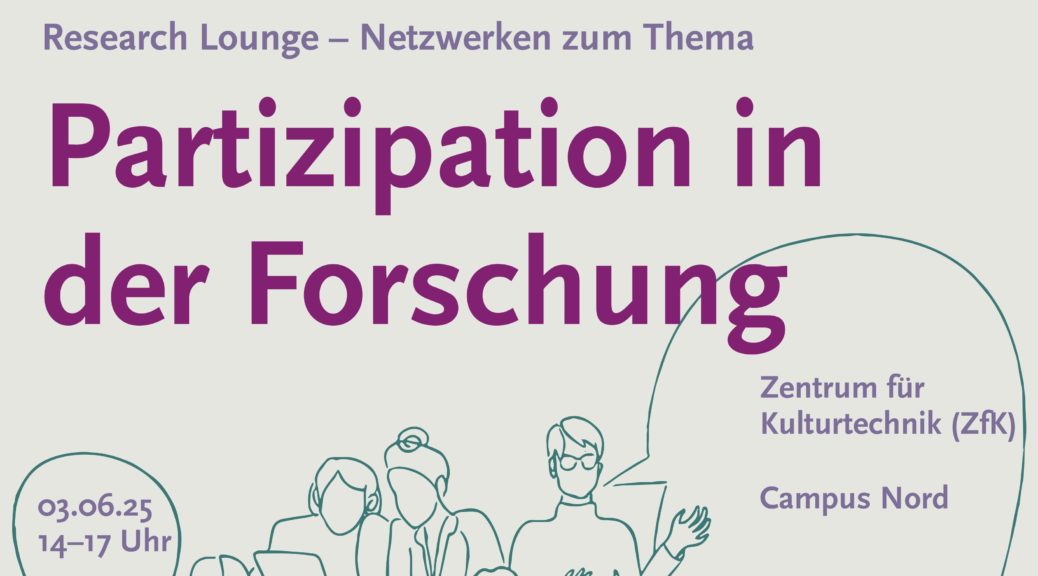
The event Research Lounge on the topic of “Participatory Approaches in Researchwill take place on Tuesday, June 3, 2025 from 2 to 5 p.m., at the Central Institute Center for Cultural Techniques (ZfK) on Campus North. Organized by the team of the Vice President Research in cooperation with the HU office for “Knowledge Exchange with Society”, researchers from Humboldt-Universität zu Berlin and its partner institutions are invited to network at this event:  Register here

Knowledge exchange with society is becoming an increasingly important part of knowledge production in research through participatory and transdisciplinary approaches. While these approaches are standard in some research areas, such as sustainability and innovation research, there is less experience and exchange in other areas. Among other research methods, participatory and transdisciplinary research methods are seen as a particularly good way to contribute innovative solutions to current societal challenges. To this end, cooperation with citizens, organised civil society, culture or politics can open up new research topics and strengthen trust in science through their active participation.

There are many definitions, methods and experiences of participatory approaches to research, as well as a wide variety of actors and forms of participation. The Research Lounge “Participation in Research” therefore aims to promote scientific exchange and networking in this area and to highlight the diversity of current research activities and examples of success at Humboldt-Universität.

Programme

2:00 p.m. – Welcome

Prof. Dr. Christoph Schneider (Vice President for Research)
Xenia Muth, Leonie Kubigsteltig, Zentrum für Kulturtechnik

2:20 p.m. – Keynote speeches

Dr. Saskia Schäfer (Institute for Asian and African Studies):
Participatory research on democracy: Insights from civic education and local decision-making

Dr. Silke Stöber (Albrecht Daniel Thaer Institute of Agricultural and Horticultural Sciences):
Participatory action research for food systems transformations: methods and challenges

Prof. Dr. Regina Römhild (Institute for European Ethnology):
Postcolonial Neighborhoods: A new experiment in collective ethnography and trans-academic collaboration

Prof. Dr. Elisabeth Verhoeven (Institute for German Language and Linguistics):
Sprachen Berlins – Languages of Berlin: mapping the city’s linguistic diversity

Prof. Dr. Miriam Bouzouita (Institute for Romance Studies):
Using Citizen Science to examine geospatial and sociolinguistic variation and change

Break

Prof. Dr. Robert Arlinghaus (Integrative Fisheries Management, IGB, IRI THESys):
Co-production of knowledge in participation changes attitudes, norms and behaviour of practitioners: Examples from fisheries research

Prof. Dr. Heike Wiese (Institut for German Language and Linguistics):
Shaping multilingualism together: Participatory research with Berlin pupils and HU students

Dr. Constanze Saunders (Professional School of Education):
‘Learning schools’ and research-based teacher training

Indrawan Prabaharyaka (Institute for European Ethnology):
Animation and Prototyping: Two transdisciplinary tools for knowledge exchange with more-than-human society

Dr. Stefanie Alisch (Institute for Musicology and Media Studies):
Reasoning Sessions und Dubdampfer – Sound System Epistemologies networks in Berlin

4:30 p.m. – Open Networking


Please register for the Research Lounge here.
If you have any questions, please visit the event website.


Research Lounge – Participatory Approaches in Research

Call for Contributions: Submit abstracts for the fifth Research Lounge on the topics of Participatory Approaches in Research until April 20, 2025.

The fifth Research Lounge will take place on Tuesday, June 3, 2025 from 2 to 5 p.m. on the topic of “Participatory Approaches in Research”, this time at the Central Institute Center for Cultural Techniques (ZfK) on Campus North. Organized by the team of the Vice President Research in cooperation with the HU office for “Knowledge Exchange with Society”, researchers from Humboldt-Universität zu Berlin and its partner institutions are invited to network at this event.

Knowledge exchange with society is becoming an increasingly important part of knowledge production in research through participatory and transdisciplinary approaches. While these approaches are standard in some research areas, such as sustainability and innovation research, there is less experience and exchange in other areas. Among other research methods, participatory and transdisciplinary research methods are seen as a particularly good way to contribute innovative solutions to current societal challenges. To this end, cooperation with citizens, organised civil society, culture or politics can open up new research topics and strengthen trust in science through their active participation.

There are many definitions, methods and experiences of participatory approaches to research, as well as a wide variety of actors and forms of participation. The Research Lounge “Participation in Research” therefore aims to promote scientific exchange and networking in this area and to highlight the diversity of current research activities and examples of success at Humboldt-Universität.

We welcome contributions from researchers at all career stages (R1-R4) and from all disciplines. The short presentations of 7 minutes can deal with empirical or theoretical scientific aspects of participatory and transdisciplinary research or with practical perspectives and experiences. The non-exhaustive list of possible presentation topics includes:

Research on participation and transdisciplinarity in science:
  • Participation and transdisciplinarity research
  • Theoretical and methodological reflections on the (further) development of participation in research
  • Responsible Research and Innovation (RRI)
  • Reflections from impact research, findings on impact and added value of participatory and transdisciplinary research
Approaches, methods, case studies:
  • Concepts and methods as well as project/context-specific application of transdisciplinary and participatory processes in research projects and teaching
  • Examples of participatory research projects and participation formats
  • Experience from areas such as participatory action research, participatory health and social research, transformation research, artistic research, co-curation, co-design, Citizen Science, shared coding/computing
Challenges and principles of transdisciplinary collaboration with a focus on:
  • Integration of heterogeneous types of knowledge, experiential knowledge, knowledge needs and expectations, project goals and desired research outputs
  • Reflections on trust, ownership, emotions, power relations including reflection on one’s own role as a researcher in the participatory research process
  • Theoretical approaches and application of quality criteria, evaluation criteria and evaluation methods

Procedure and further information

  • The planned short presentations should not exceed 7 minutes.
  • If you are interested in giving a presentation, please send an abstract (approx. 100 to a maximum of 250 words) to vpfref[at]hu-berlin.de by April 20, 2025 at the latest.
  • The event languages are German and English.
  • Speakers will be notified by May 6, 2025.
  • The event will take place at the Central Institute ZfK (Centre for Cultural Techniques) and will be co-supervised by the HU office for “Knowledge Exchange with Society”.

If you have any questions, please contact the organizers of the Research Lounge at vpfref[at]hu-berlin.de or consult the event website.

Photo: Nadine Zilliges, Humboldt-Universität zu Berlin

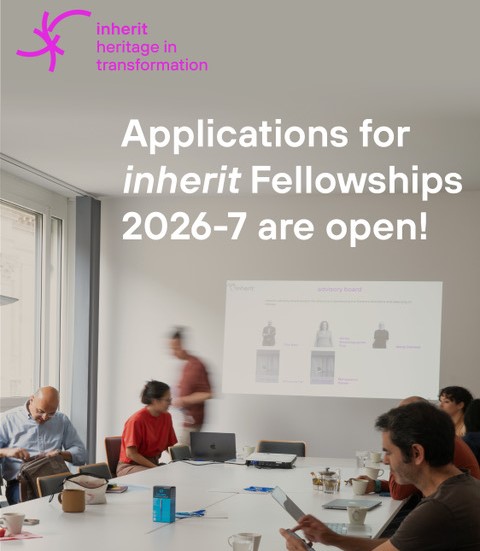
Open Call for inherit Fellowships 2026-2027

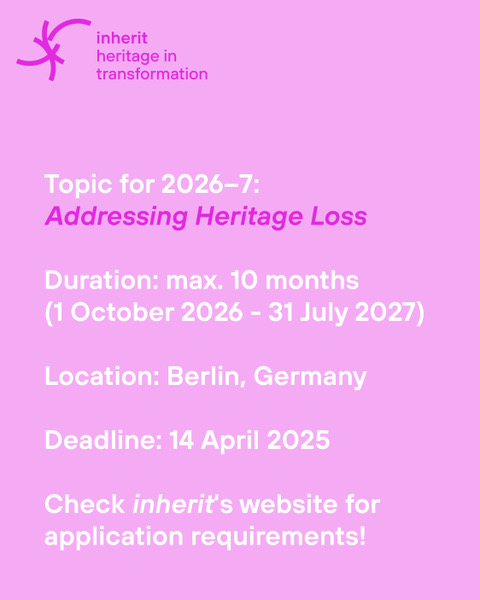
The Centre for Advanced Study inherit. heritage in transformation, a BMBF-funded Käte Hamburger Kolleg based at Humboldt-Universität zu Berlin, is pleased to invite applications for its fellowship program, which will run from 1 October 2026 to 31 July 2027. This opportunity is open to both experienced and early-career postdoctoral researchers, as well as artists, filmmakers, and curators.

📅 The deadline for submission is 14 April 2025.

The Centre explores historical, contemporary, and potential future transformations in heritage and hosts up to fifteen international fellows each year to pursue their research. The topic for applications for fellowships for 2026-7 is Addressing Heritage Loss. Applications should also relate to one or more of our guiding themes: decentring the west. decentring the human, and transforming value.

Researchers and topics from areas currently underrepresented in heritage scholarship, including the global South and Eastern Europe, are especially encouraged to apply.

🔗 For more information about the call, see https://inherit.hu-berlin.de/open-call

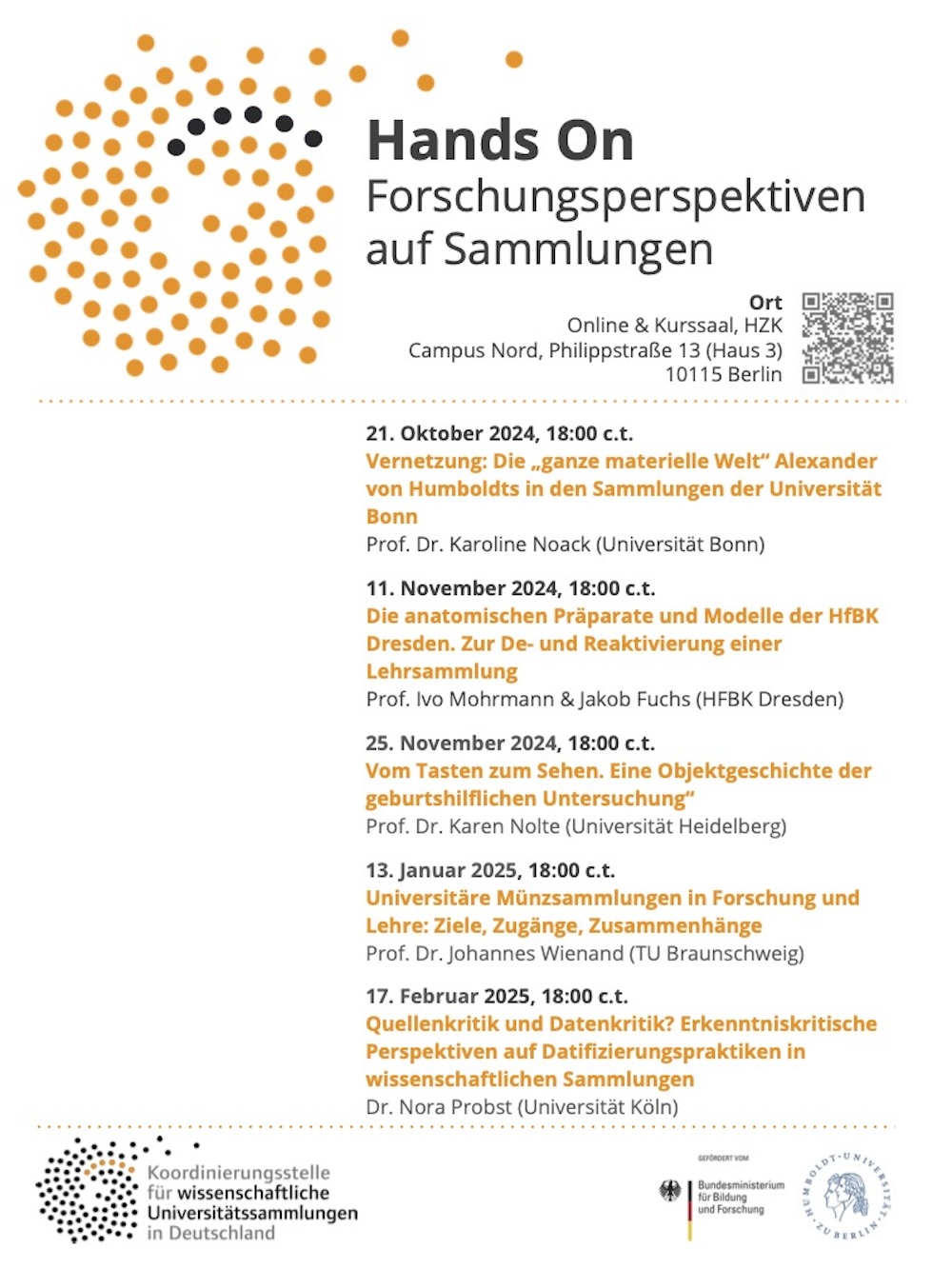
Lecture series “Hands On. Research Perspectives on Collections” – winter semester 2024/25

The lecture series ‘Hands-on. Research Perspectives on Collections’ explores the question of how researchers in their respective disciplines access collections and objects, how they question and utilise them for their research topics and which theoretical and methodological approaches they use to do so. Academics from the fields of Ancient American Studies, Conservation and Restoration Science, History of Medicine, Numismatics and Film Studies will present examples of collection and object research in their disciplines and will also discuss their research projects from the BMBF funding programme ‘Vernetzen – Erschließen – Forschen. Allianz für Hochschulsammlungens’ (https://wissenschaftliche-sammlungen.de/de/allianz2/).

Organisers:
Sarah Elena Link and Gesa Grimme
Coordination Centre for Scientific Collections in Germany (https://wissenschaftliche-sammlungen.de/de)

Time and Place:
The events take place on Mondays from 6 to 8 p.m. at Kurssaal, Helmholtz-Zentrum für Kulturtechnik, Campus Nord, Humboldt-Universität zu Berlin. Afterwards, there will be an opportunity to network and exchange ideas over a small drink. There is also the possibility to participate via Zoom.

Participation:
Participation is possible without pre-registration and is free for all interested parties!

Programme and Zoom link:
https://wissenschaftliche-sammlungen.de/de/allianz2/ringvorlesung/

Poster Ringvorlesung Hands On
Lecture series “Hands On. Research Perspectives on Collections”

Research topic “Water”: Call for contributions across all disciplines

The Berlin University Alliance (BUA) cordially invites all members of the four partner universities in the design of a joint format as part of Objective 2 “Fostering Knowledge Exchange”. An inter- and transdisciplinary exhibition project with “Water” as its central topic is currently being developed in collaboration with the Helmholtz-Zentrum für Kulturtechnik (HZK) at HU and the Humboldt Labor team for 2025.

To enable the project to incorporate the ideas and expertise of all BUA partners, we would like to get an overview of the research being carried out at the four institutions dealing with the element of water in the narrower and broader sense – for example in terms of the properties of water, its functions e.g. as a catalyst or as a carrier substance, water infrastructures, or water with ecological, political, social, as well as historical, cultural, aesthetic or religious implications.

We look forward to receiving numerous and wide-ranging responses from you, regardless of the stage of your academic career.

We ask all researchers, doctoral candidates and students who feel that this topic isrelevant to them and who would like to contribute to it by sharing their research with a broader public to submit an initial expression of interest here by Feb. 15, 2024.

At this stage we are simply looking to gain an overview of available research and would later on approach you with a shortlist of questions (6 questions). You are of course free to decide at a later stage whether you would like to be more closely involved in this project or not. First of all, we would like to make sure to draw a broad and diverse picture as possible of the lively research at the BUA institutions. We would therefore be very pleased to have you participate in this quest. For further questions please contact Leonie Kubigsteltig or Xenia Muth, working in the field of knowledge exchange at HZK: wasser@berlin-university-alliance.de

Prof. Dr. Eva Ehninger,
on behalf of Objective 2 “Fostering Knowledge Exchange” (BUA)

Expression of interest project “Water”

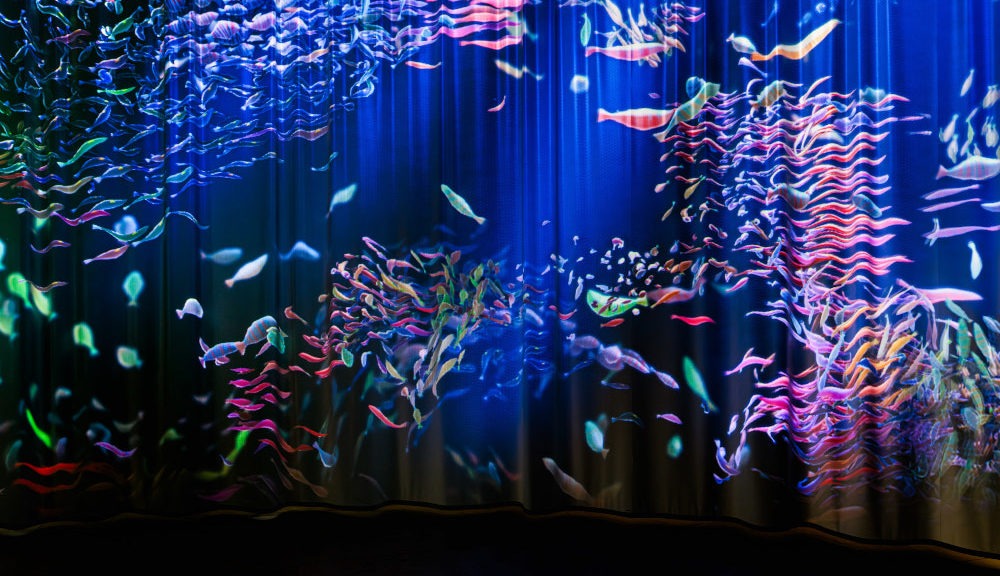
Image: Interactive curtain in the entrance area of the Humboldt Laboratory © HU / schnellebuntebilder. Photo: Philipp Plum